Exploring Ancestral Memories and ‘Lost Family Histories (7/2025)
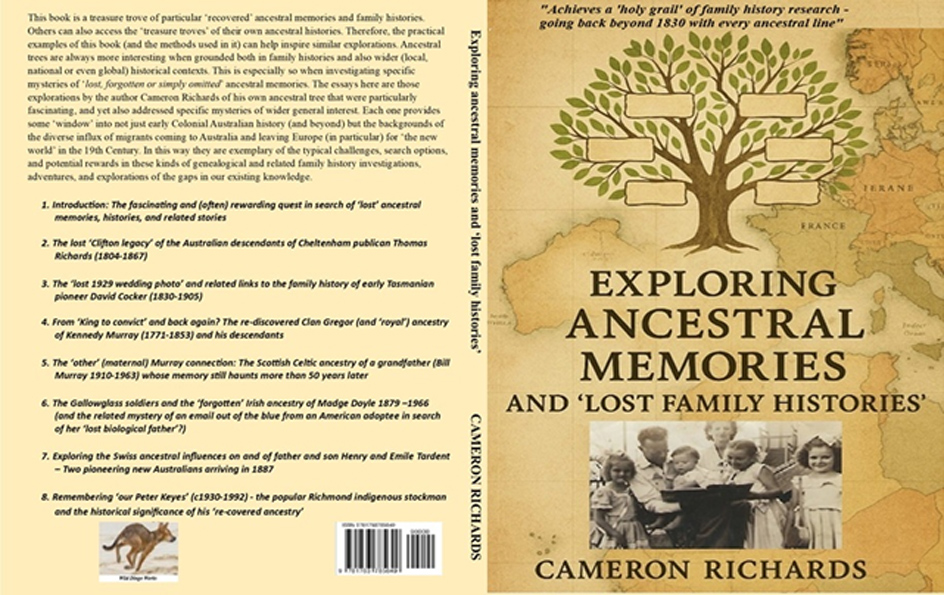
HARDCOPY FORMAT : 161 Pages in A4 size (21 x 28 CM)
ISBN: EBOOK (1763785645), PAPERBACK (9781763785649) & HARDBACK 97817637856870
TO BUY GO TO : https://www.amazon.com.au/dp/1763785645
TO ADD A REVIEW GO TO : https://www.amazon.com/review/create-review?&asin=1763785645
DOWNLOAD A FREE SAMPLE VERSION HERE : https://drive.google.com/file/d/1aJfcLy9K_C85t03MYZ8L5mlVHtJthyC0/view
OVERVIEW :
This book is a treasure trove of particular ‘recovered’ ancestral memories and family histories. The important thing is that others can also access the ‘treasure troves’ of their own ancestral histories – and hopefully the practical examples of this book (and the methods used in it) can help inspire similar explorations. Ancestral trees are always more interesting and relevant when grounded both in family histories and also wider (i.e. local, national or even global) historical contexts. This is especially so when investigating specific mysteries of ‘lost, forgotten or simply omitted’ ancestral memories. The essays here are those explorations by the author Cameron Richards of his own ancestral tree that were particularly fascinating, and yet also addressed specific mysteries of wider general interest. Each one provides some ‘window’ into not just early Colonial Australian history (and beyond) but the backgrounds of the diverse influx of migrants coming to Australia and leaving Europe (in particular) for ‘the new world’ in the 19th Century. In this way they are exemplary of the typical challenges, search options, and potential rewards in these kinds of genealogical and related family history investigations, adventures, and explorations of the gaps in our existing knowledge.
CONTENTS :
| 1. | Introduction: The fascinating and (often) rewarding quest in search of ‘lost’ ancestral memories, histories, and related stories. | page 1 – 10 |
| 2. | The ‘lost Clifton legacy’ of the Australian descendants of Cheltenham publican Thomas Richards (1804-1867)
| page 11 – 30 |
| 3. | The ‘lost 1929 wedding photo’ and related links to the family history of early Tasmanian pioneer David Cocker (1830-1905)
| page 31 – 47 |
| 4. | From ‘King to convict’ and back again? The re-discovered Clan Gregor (and royal) ancestry of Kennedy Murray (1771-1853) and descendants
| page 49 – 70 |
| 5. | The ‘other’ (maternal) Murray connection: The Scottish Celtic ancestry of a grandfather (William Saunders Murray 1910-1963) whose memory still haunts more than 50 years later on | page 71 – 86 |
| 6. | The Gallowglass soldiers and the ‘forgotten Irish ancestry’ of Madge Doyle 1879 –1966 (and the related mystery of an email out of the blue from an American adoptee in search of her ‘lost biological father’?) | page 87 – 107 |
| 7. | Exploring the Swiss ancestral influences on and of father and son Henry and Emile Tardent – Two pioneering new Australians arriving in 1887
| page 109 – 135 |
| 8. | Remembering ‘our Peter Keyes’ (c1930-1992): The popular Richmond indigenous stockman and the significance of his ‘re-covered ancestry’ | page 137 – 142 |
ADDITIONAL THOUGHTS :
The ‘holy grail’ of genealogy linked to family history research – going back beyond the 1830s ‘in every direction’?
As many Australian genealogy researchers will be aware, it was not until 1837 (and roughly that time in many other European countries) that the UK government took over from the various religious parishes the responsibility for collecting records of births, deaths and marriages. But of course there are many other additional challenges searching back in time to investigate ancestral records – incomplete records, the confusion of names, and the gaps found that may be either errors or omissions.
So not only is luck often needed, but some different search strategies when such searches become ‘difficult’. Am sure there will be many others agree that whilst some of the ‘rabbit holes’ that we venture into in exploring family history myths and mysteries can be a bit frustrating. But it can be a very rewarding experience (and perhaps a little addictive) when answers are found to the questions or searches made.
After I first got interested in tracing different lines of my ancestral tree some years ago I wondered about the possibility of going back beyond 6-7 generations – and also back in time ‘in every direction’ beyond the 1830s. This was after I had had some luck with searching earlier parish records in exploring my ancestral tree. I then became even keener on pursuing mainly to re-discover lost or forgotten family histories as well as ancestral memories.
Just recently I reached my target of a full and at least ‘reasonably confirmed’ an ancestral tree for interested grandchildren in the future to go back around 7 generations – with many of the related family lines also back beyond 1837. As this doubles each generation (2-4-8-16-32-64). Just going back five generations from myself involved trying to verify 32 different lines (see cover attached).
And because the investigations had involved many fascinating family history stories linked closely to revelations about early Australian local, regional and even national histories, one of my key insights turned out to be that an interest in ‘history’ can greatly benefit genealogical research (and vice versa). In pursuing some of the most fascinating lines of lost family research (and related ancestral memories) back I started to write up accounts for different groups of related cousins. And in those accounts (which were also selected for their ‘general interest’ links – especially to the formation of Australia as a nation not just a colony of the UK) I also shared many of my tips and insights for the most effective or optimal ancestral and family history research.
And suddenly, without really planning to do this, I had suddenly written a book which I self-published last month as an e-book as well as paperback at close to cost price to be able to encourage younger cousins to take an interest – as well as share some of my own excitement and fascination with such a wonderful hobby and interest.